
Why Some Foreign Villa Owners in Bali Are Selling Below Market Price — And How NIB Rules Are Changing the Competition
Over the past year, Bali’s property market has entered a new phase. In areas such as Uluwatu, Canggu, Pererenan, Bingin, and Balangan, more villas owned or operated by foreigners have quietly appeared on the market with noticeably reduced asking prices. Some owners are willing to accept lower offers simply to exit quickly, while others are struggling to keep their villas listed on major online travel platforms. Behind many of these sales is a growing issue that has become increasingly important across Bali’s hospitality industry: the requirement for proper business licensing, especially the NIB.
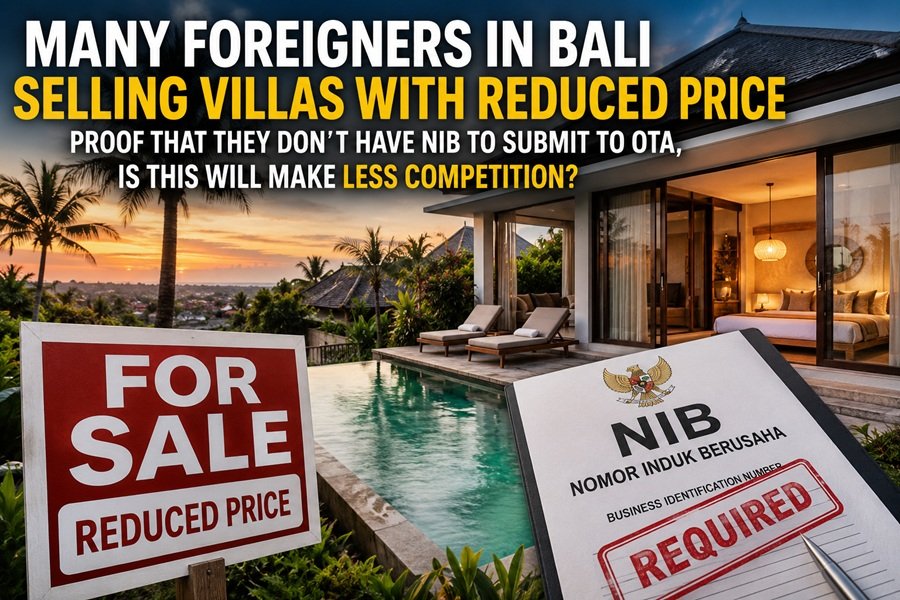
The NIB, or Nomor Induk Berusaha, has become one of the most discussed topics among villa operators because online travel agencies are tightening compliance requirements. Platforms such as Airbnb and Booking.com are under increasing pressure to ensure that accommodations listed in Bali comply with Indonesian regulations. Villas operating without proper permits now face greater difficulty maintaining visibility, receiving payouts, or even remaining active on some OTA systems.
For years, many foreign investors entered Bali’s booming villa market during periods of rapid tourism growth. Some purchased leasehold properties through local arrangements, while others built villas assuming that tourism demand would continue rising indefinitely. During the post-pandemic recovery, occupancy rates surged, nightly prices climbed, and many owners believed Bali villas would remain highly profitable with minimal regulation. However, as the market matured, government oversight increased and competition intensified dramatically.
Today, Bali faces a massive supply of villas across popular tourism zones. In some neighborhoods, travelers can scroll through hundreds of similar properties offering private pools, tropical interiors, rooftop lounges, and jungle or ocean views. This oversupply has made compliance and operational legality more important than ever. Villas without complete documentation now face disadvantages not only with government monitoring but also with digital distribution channels that drive international bookings.
Some foreign-owned villas that lack proper NIB registration are reportedly struggling to maintain stable occupancy because OTA compliance systems increasingly request legal business information connected to accommodation operations. Owners unable to meet these requirements may experience reduced online exposure or operational uncertainty. As a result, several property holders are choosing to sell rather than continue navigating legal adjustments, tax obligations, or business restructuring.
The reduced prices seen in parts of Bali’s villa market are not necessarily proof that the tourism sector is collapsing. Bali remains one of the world’s strongest leisure destinations, with international arrivals continuing to recover and infrastructure development expanding across the island. However, the era of easy profits from unregulated villa operations is beginning to fade. Buyers are becoming more cautious, and experienced investors now pay closer attention to licensing, zoning, tax structure, and operational legality before purchasing property.
In areas like Balangan and Uluwatu, some villa operators who already possess complete business documentation may actually benefit from these changes. As authorities and OTAs become stricter, legally compliant villas could face less unfair competition from informal operators. In previous years, many unregistered villas competed aggressively on price because they avoided certain operational costs and legal obligations. If more non-compliant properties leave the short-term rental market, professionally managed villas with proper permits may gain stronger positioning and better long-term sustainability.
At the same time, lower-priced villa sales may create opportunities for serious investors willing to operate correctly within Indonesian regulations. Some buyers see the current market as a transition period rather than a crisis. Properties with strong locations near beaches, surf spots, restaurants, and tourism infrastructure still hold long-term value, especially when supported by proper legal structure and professional management.
The situation also reflects a broader shift happening across Bali tourism. Travelers are increasingly expecting reliable service standards, verified accommodations, secure payment systems, and professional hospitality operations. OTAs themselves are prioritizing legal clarity because international consumers expect safer and more transparent booking environments. Villas that adapt to these expectations may remain competitive even as the market becomes more regulated.
For local villa owners and hospitality businesses, the current environment may ultimately create a healthier market. While short-term pressure exists due to oversupply and regulatory tightening, stronger enforcement could gradually reduce unstable operators and improve the reputation of Bali’s accommodation industry overall. The villas most likely to survive the next phase of Bali tourism are not necessarily the cheapest, but the ones that combine strong locations, legal compliance, professional operations, and consistent guest experience.
Bali’s villa market is no longer driven only by rapid expansion. It is entering a more mature stage where legality, transparency, and operational structure matter as much as architecture and location. For some foreign owners, this shift has become difficult to manage, leading to discounted sales and market exits. For compliant operators, however, the same transition could eventually mean reduced competition and a more sustainable future for Bali’s hospitality sector.
Bali Villas Articles
- Bali International Hospital Hub with Bali Villas in Sanur
- Bali Visa Guide 2025
- Romantic Bali Villa Getaways
- Wellness Villas in Bali: Health & Nature Inspired Vacation Homes
- Bali Airport Prepares for Hantavirus Concerns: What Tourists Need to Know in 2026
- Why Foreigners in Bali Are Selling Villas Cheaply Due to NIB and OTA Rules
- Best Places to Build a Villa in Bali
- ROI Realities: Investing in Bali Villas in 2026
- Why Bali Villa Occupancy Is Down: Oversupply, Pricing & Global Travel Costs
- Canggu Bali: Full of Tourists and Villa Developments Even in Low Season
- Seminyak Beach Bali — Still a Luxury Destination Amid Erosion Challenges
- Why Jimbaran Is Bali’s New Luxury Villa Hotspot in 2025 | Bali Villas Guide
- Bali Villa Registration Gap: The Hidden Crisis Behind Unlicensed Rentals
- Amed Villas Development | New Bali Tourism & Villa Investment Destination
- Overtourism, Regulation & Crime: Bali Villa Owners Facing New Challenges
- Bali Diving Adventure | Explore Bali’s Underwater World Near Luxury Villas
- Bali Trekking Around Bali Hidden Trails and Stay in Scenic Bali Villas
- New OTA Rules Indonesia: Property Listings Must Have NIB in 2026
- Kelingking Beach Nusa Penida Glass Lift Controversy